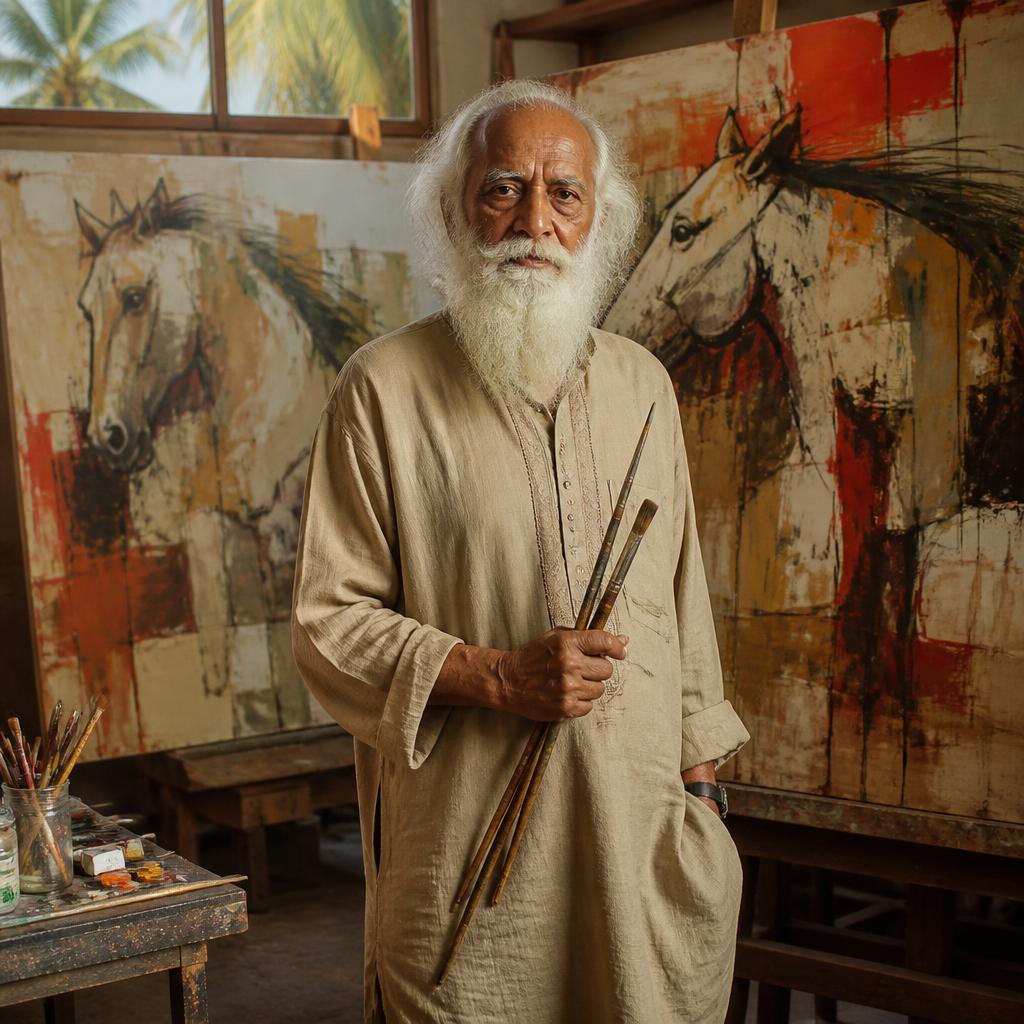
M.F. Husain
India's 'Picasso' and founding member of the Progressive Artists' Group. Known for his bold, kinetic horses and a lifetime devoted to reimagining Indian iconography.
The painter who taught India a new way of seeing.
Maqbool Fida Husain began as a painter of cinema hoardings in 1940s Bombay — and never lost that hoarding scale, that hoarding confidence. By 1947 he was a founding member of the Bombay Progressive Artists' Group, the seismic break with the Bengal School that pulled Indian art into international modernism.
His horses — sinewy, mid-leap, sometimes Marwari, sometimes mythical — became the most recognisable motif in 20th-century Indian painting. Across seven decades he reimagined Mother Teresa, the Mahabharata, the Indian village, the British Raj, and India's cities, all in a flat, calligraphic, joyously coloured idiom.
Knighted by Qatar in his final years, painting until the end, Husain remains the only Indian artist whose name the world knows on sight.
"Painting is the only weapon by which I can fight."
The Defining Canvases
Horses (series)
His lifelong motif — energy, freedom, India itself.
Battle of Ganga & Jamuna
Mahabharata as a tapestry of clashing colour planes.
Mother Teresa series
Faceless white-draped figures of universal compassion.
Last Supper
Indian translation of Leonardo's iconography.
Indian Civilisation (Bharat Mata cycle)
Final monumental cycle, painted in exile.
Timeline
- 1915
Born in Pandharpur, Maharashtra.
- 1947
Founding member of the Bombay Progressive Artists' Group.
- 1955
Awarded the Padma Shri.
- 1971
Invited as Special Guest, São Paulo Biennale, alongside Picasso.
- 1991
Awarded the Padma Vibhushan.
- 2010
Accepts Qatari nationality after years of self-exile.
- 2011
Dies in London at the age of 95.
Where to See the Originals
Select museums and foundations holding works by M.F. Husain.
Collect a Master
Discover authenticated works, lithographs and editions by M.F. Husain and India's other legendary masters — live in our auction rooms now.